Intro to Stereotomy
Hand-drafting for complex wooden forms
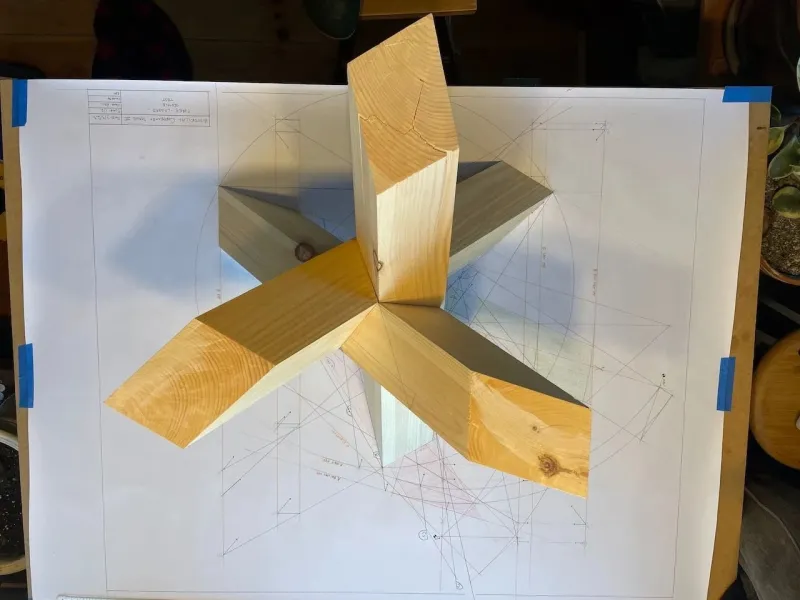
This course offers an introduction to stereotomy, a traditional hand drafting technique that uses lines, projection, and proportion to compute complex geometry in 3D without the use of numeric computation. It has been used to create some of the world's finest historic architecture, including Gothic cathedrals in France and Buddhist temples in Japan. The material learned in this class is directly applicable to hip and valley roof framing, splay-legged furniture, and other challenging geometric forms in a variety of media.
Our study project will be a Japanese splay-legged stool with four legs and compound mortise-and-tenon joinery. Each student will create their own full-scale stereotomy drawing of the stool using triangles, straightedge, and compass. Then, each student will use their drawing to produce their own stool to take home. All layout will be transferred physically from the page onto the wooden parts without the use of numeric measurement.
We will touch on some numeric math as a complement to the stereotomy approach, but this class will primarily focus on hand drawing as a non-numeric approach to solving complex geometric layouts.