
October 8, 2025
2025 Semester Week 1: Relationships
One of the most valuable pieces of wisdom that was offered to us during our first week at Yestermorrow was a thought given on relationships by our harvesting and milling instructor, Nick Zandstra. Awareness of your relationships with the land, plants, materials, and tools that you are working with better allows you to communicate with them and thus have higher-quality relationships. In the relationship between yourself and a tree that you are hoping to harvest and build with, it is important to, in a way, communicate with the tree and to intuit if this harvesting is sensed and allowed by the tree and the surrounding ecosystem. Sometimes a tree needs to be cut down, shown by a variety of signals that it is diseased, dying, or a threat to a nearby structure. Sometimes you are able to see that removing it from its place will bring more harm to its surrounding ecosystem than the perceived value your building will bring to its surrounding site. Realizing that every building scenario has multitudes of these relationships built into it allows you to have a more intimate relationship with each of these individual things, and therefore, to strengthen your approach to the building process as a whole. You may have a strong relationship with a hammer that you bought for ten dollars, and a weak one with an axe that you bought for a hundred dollars. Often, all that you can change is your approach to the relationship (i.e. leaving the relationship, changing your approach to the problem). Honing this sense of intuition will also fare well in interpersonal relationships, where you will easily be able to feel a “first blush of a good relationship”. This semester will be full of relationships like this, which we began to establish with each other on the first night that we arrived, Sunday evening. There are eight students this year, three main instructors, one TA, and several dogs that will be roaming alongside.
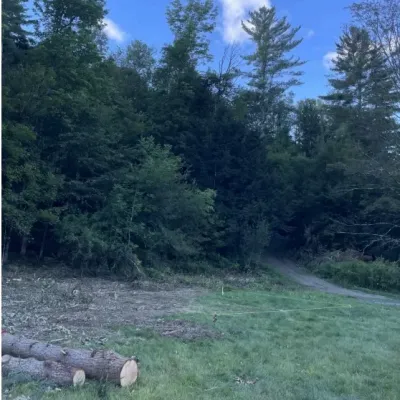
Monday was full of establishing relationships with the Yestermorrow community, campus, and surroundings. An amazing part of Yestermorrow is the intimate size and feeling of the place, which lends itself to placing a lot of value in really getting to know each person that comes through its doors. The morning included several tours, including the campus run-down, punch bowl swimming hole promotions, kitchen do’s-and-do-nots, etc. We had the chance to look at our future building site, which measures to about 300’ in area, and is situated along the path that runs up to the bunkhouse, by the trailhead leading up into the forest. With interlocked hands and fingers, all 12 of us were barely able to span the perimeter of the site. More in-depth introductions were made soon after each student was united by a common love for alternative design, though our backgrounds and dreams greatly differed. The afternoon placed us into the van, on an extremely short ride to the Waitsfield 10 Property. Minutes before, we had seen the balsa wood model render of the Waitsfield 10 building, and the actual sight was even more impressive. The body consists of a series of rotated rectangles, starting with the initial footprint, and then seemingly disappearing into thin air, symbolizing a divergence of creativity and funding in a project’s creation. A massive beam extends along the top of the building, reaching beyond the actual footprint and then sharply turning down, where it rests upon a concrete foundation. Hearing about the building is not enough to encapsulate the feeling- it must be seen to be grasped. Mac and Bobbie Rood, the current owners and occupants of the house, kindly gave us a tour and answered the avalanche of questions that we all had, starting with their experience with renovating the house from the bare bones condition it had been in when they first bought it. The site is made up of 8 subdivided lots, all of which are meant to serve as affordable housing plots, with access to a community wastewater system and shared wells. We toured the whole area, seeing a variety of examples in creativity and sustainability.
Our second day on campus brought about an entirely new experience with harvesting and milling trees, taught and aided by Nick Zandstra. The day started with a brief on some essentials of wood harvesting that will be especially applicable to our semester building, like assessing moisture content and ensuring that wood is fully dried before using. We walked the campus, looking at different examples of trees and their unique properties for general tree identification. While traipsing, we walked up the trail to a clearing on the left where another course had felled some trees a few days before. A towering hemlock was identified as a tree to harvest for our future building. As an example of how to safely fell a tree, Nick took us to look at one that stood beside the fire pit on the basketball court. The tree was a danger to the structures beside it, and its growth had been slowing, showing its descent into death. The Soren Ericsson method for chainsawing was used to fell, as it is the most predictable (i.e. safest) method of cutting, which involves cutting a “latch” out of the tree side. Several of the latches cut during the span of the day were taken as sentimental objects, their scents perfuming the rooms they were placed in. Watching the hemlock fall was awe-inspiring, and almost saddening. The splitting of a giant, the crash of its trunk against the forest floor. Excess branches were sawed off, and the trunk cut into long sections. The rest of the afternoon was spent in almost 1800s fashion, using peaveys to roll the trunk sections and chains with pulleys to drag them off the steep slope. Everyone tried their hand at the work, and by the end of the school day, we were working as a well-oiled machine.
Wednesday morning began with slightly haggard faces after the soreness of yesterday’s activities had set in. Regardless, we set out again to continue our work of moving the hemlock trunks to the portable sawmill, along with some ash sections cut by an earlier class. Using log arches to leverage and lift the front ends, we maneuvered them towards the basketball court. Though portable, the sawmill was still quite large, and skinning the bark (also called fletch as cutoff pieces) off of the sections happened quickly. Beautiful sixteen-foot boards were created out of the hemlock, and the ash produced sections with mirrored dark heartwood amongst the rest of the stark white flesh. We laid the boards upon stickered piles to dry, and moved some over to the solar kiln so that they could dry more quickly and predictably. In the afternoon, we placed sentimental objects in the center of a circle formed in the woods and were led in a meditation. Once that peace had descended upon us, we journeyed off into various parts of campus to find our future “sit spots” and establish relationships with these places of refuge. These spots also served as a basis for our first assignment, which was to represent them using a variety of mediums, based around terms that expressed some aspect of their essence (e.g. disorder, materiality, compression). We spent the rest of the evening working on these representations.
Thursday morning was a continuation of the milling progress we had made. The boards were finished, and we asked any remaining questions that we had about tree types and harvesting. We shared our representations of our sit spots later on, and explained the different examples of word emphasis and why we chose them. It was our first time sharing work with the group and receiving constructive criticism for ways to enhance our representations for the next phase of the project, which was to illustrate our sit spots with 3D paper models.
Friday morning brought drizzle and darkness as we set into a discussion of Architectural Improvisation, a book on the history of the Design/Build movement in Vermont. Danny Sagan’s synopsis of the movement was quite thought-provoking, and especially interesting because we had been able to view one of the iconic houses mentioned, the Waitsfield 10 building, earlier in the week. Establishing our relationship to the design-build movement, and to Yestermorrow’s history, allowed us to visualize how we will be approaching the process of building our house structure on campus. Ideas surrounding process art, wild beam theory, sustainability, and creativity throughout the 60s and 70s in the Prickly Mountain site stirred our imaginations. The afternoon involved our first trip out to the hangar on the basketball court, where we received guidance on hand tool usage and safety. We began to visualize how many of our days would be spent for the rest of these four months: covered in sawdust, laughing, and eager to keep learning. Most rise early on campus, and see the first glimpses of sun rays stretching over the mountain as breakfast rolls on. Our future site receives the rays a little while later, because of the closely watching tree-line to its back. Anticipation is building, and so are we.
-Anoushka Pschorr, 2025 Semester student